Peer Review Process
All manuscripts submitted to the ASEAN Journal of Science and Engineering (AJSE) are processed through the journal's online submission system and undergo an editorial assessment and peer review process before a publication decision is made. AJSE applies a blind peer-review process to ensure that manuscripts are evaluated objectively and fairly by qualified researchers with relevant expertise.
The final decision regarding acceptance, revision, or rejection is made by the Editor or Editorial Board, taking into consideration the reviewers' assessments, the scientific quality of the manuscript, its relevance to the journal's scope, originality, methodological soundness, and overall contribution to the field.
1. Initial Editorial Screening
Upon submission, each manuscript undergoes an initial screening by the journal manager and/or editors. This stage evaluates whether the manuscript:
-
is within the scope of AJSE;
-
meets the journal's basic submission requirements;
-
demonstrates sufficient originality and scholarly contribution;
-
follows the required manuscript format and structure;
-
satisfies applicable publication ethics requirements; and
-
contains no apparent plagiarism or inappropriate text reuse.
A plagiarism/similarity check using Turnitin is conducted as part of the initial screening process.
Based on the results of this assessment, the editor may:
-
proceed with the manuscript to peer review;
-
request technical or editorial corrections before further processing; or
-
reject the manuscript at the editorial stage if it does not meet the journal's basic requirements or falls outside the journal's scope.
An editorial rejection at this stage does not necessarily indicate that the research itself is scientifically invalid; rather, it indicates that the manuscript does not satisfy the journal's requirements for further consideration.
2. Peer Review
Manuscripts that pass the initial editorial screening are forwarded to qualified reviewers whose expertise is relevant to the subject of the manuscript.
AJSE normally seeks assessments from at least three reviewers, consisting of at least one internal reviewer affiliated with Universitas Pendidikan Indonesia and external reviewers from other institutions, subject to reviewer availability and the editorial circumstances of individual submissions.
Reviewers evaluate manuscripts based on relevant criteria, including:
-
originality and significance of the research;
-
relevance to the scope of AJSE;
-
clarity of the research objectives and problem formulation;
-
adequacy and rigor of the methodology;
-
validity and reliability of the results;
-
quality of analysis and interpretation;
-
consistency between the results and conclusions;
-
contribution to the advancement of science and engineering;
-
quality and relevance of the references; and
-
clarity and overall presentation of the manuscript.
The identities of reviewers and authors are protected in accordance with the journal's applicable blind-review policy.
Authors should not contact reviewers directly regarding manuscripts under review. Likewise, reviewers should communicate their assessments through the journal's designated review system rather than directly with authors.
3. Editorial Decision
Following completion of the peer-review process, the Editor or Editorial Board evaluates the reviewers' comments and recommendations and determines the appropriate editorial decision.
The editor is not necessarily required to follow a reviewer's recommendation verbatim. The final decision is based on the overall evaluation of the manuscript, the consistency and substance of the reviewer reports, the manuscript's scientific contribution, and the journal's editorial standards.
The possible editorial decisions are
a. Accept
The manuscript is considered suitable for publication in its current form. Only routine editorial or production checks may be required before publication.
b. Minor Revision
The manuscript is considered potentially publishable but requires relatively limited corrections or clarifications. Authors are required to revise the manuscript in accordance with the editor's and/or reviewers' comments before final acceptance.
c. Major Revision
The manuscript demonstrates sufficient potential for publication but requires substantial revisions. Authors are expected to address the reviewers' and/or editors' comments comprehensively. A revised manuscript may be returned to the original reviewers for further evaluation.
d. Revise and Resubmit
The manuscript requires substantial improvement before the journal can make a further publication decision. The revised manuscript will be treated as a new stage of editorial consideration and may undergo another round of peer review. Revise and resubmit does not constitute a guarantee of eventual acceptance.
e. Reject
The manuscript is not considered suitable for publication in AJSE. A rejected manuscript will not proceed to publication in its current form. Where appropriate, the editorial decision may include the principal reasons underlying the rejection.
4. Revision and Resubmission
When revisions are requested, authors should carefully consider all comments provided by the reviewers and editors.
The revised submission should normally include:
-
a revised version of the manuscript;
-
a detailed response to the reviewers' comments; and
-
a clear indication of the changes made in the manuscript, where requested.
Authors should respond to each substantive reviewer comment individually. When an author does not agree with a particular recommendation, the response should provide a clear and academically justified explanation.
The revised manuscript is submitted through the same online submission system and follows the subsequent editorial workflow.
A revised manuscript may be returned to the original reviewers or assigned to other reviewers at the discretion of the editor.
5. Multiple Rounds of Peer Review
A manuscript may undergo more than one round of peer review when substantial revisions are required.
The first cycle consists of:
Manuscript Submission → Initial Screening → Peer Review → Editorial Decision → Revision Request
When revisions are requested, the author submits a revised manuscript and the manuscript enters a subsequent evaluation cycle.
The number of review rounds may vary depending on the extent of the revisions required and the reviewers' assessments. The editorial team may conclude the review process when sufficient evidence is available to make a publication decision.
6. Acceptance and Publication
Once the manuscript satisfies the editorial and peer-review requirements, the editor issues a formal acceptance decision.
Accepted manuscripts proceed to the production stage, which may include:
Acceptance → Copyediting/Production → Galley Proof → Author Proofreading → Publication
During the galley-proof stage, authors are expected to check the manuscript carefully for typographical, factual, formatting, author-affiliation, and production errors.
Substantive changes to the scientific content should not normally be introduced at the proof stage unless approved by the Editorial Office.
The final article is published according to the journal's publication schedule and applicable publication policies.
7. Communication and Confidentiality
All editorial and peer-review communications should be conducted through the journal's official submission and communication channels.
Authors and reviewers should not attempt to circumvent the journal's review system by communicating directly with one another about a manuscript under review.
Peer reviewers are expected to maintain the confidentiality of manuscripts and should not disclose, reproduce, distribute, or use unpublished information obtained during the review process for purposes unrelated to the review.
Editorial decisions and reviewer comments are communicated to authors through the journal's official system.
Where an author wishes to seek clarification regarding an editorial decision, the request should be submitted through the journal's official communication channel and will be considered in accordance with the journal's applicable editorial policy.
8. Summary of the Peer Review Workflow
The AJSE peer-review workflow can be summarized as in following figure and description:
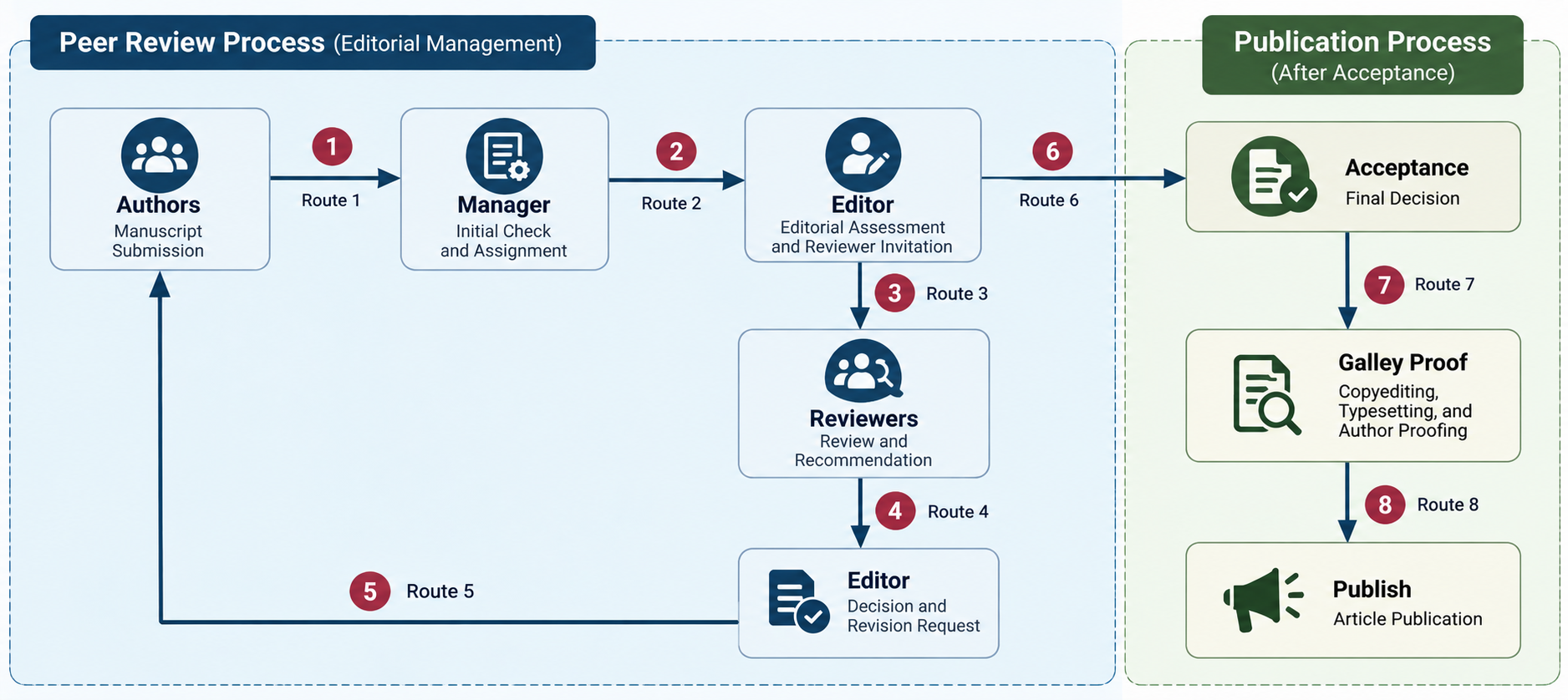
Route 1 — Manuscript Submission
The author submits the manuscript through the AJSE online submission system.
Route 2 — Initial Check and Editorial Selection
The journal manager and editors conduct an initial technical, scope, originality, and ethical assessment. A plagiarism/similarity check is also conducted. The editor may proceed with peer review, request preliminary corrections, or reject the manuscript at the editorial stage.
Route 3 — Reviewer Assignment and Review
The editor assigns qualified reviewers with relevant subject expertise. AJSE normally seeks assessments from at least three reviewers, including internal and external reviewers in accordance with the journal's reviewer policy.
Route 4 — Review Reports and Editorial Assessment
Reviewers evaluate the manuscript and provide comments and recommendations. The editor considers the review reports together with the manuscript's overall quality and contribution.
Route 5 — Editorial Decision and Revision
The editor communicates the decision to the author. If revisions are required, the author revises the manuscript and submits a revised version through the journal system.
Route 1 — Resubmission
The revised manuscript follows the applicable editorial workflow and may be returned to reviewers for further assessment.
Route 6 — Acceptance
When the manuscript has satisfactorily addressed the reviewers' and editors' concerns, the editor issues the acceptance decision.
Route 7 — Galley Proof
The accepted manuscript enters the production stage and is prepared for author proofreading.
Route 8 — Publication
After the production and proofing process is completed, the article proceeds to publication.